The buildout is real. The oil shock is immediate. The capability jump is the story.
September 8, 2026 • Updated 10AM ET •
Track the live AI stack: The AI Power 100 follows models, chips, power, cooling, optics and financing. Momentum rank is context, not a recommendation.
Open the index → THE TAPE
FAST READ
• Supply shock: Brent neared $100 as two shipping chokepoints came under pressure.
• Market verdict: futures and crypto softened, but the move was orderly rather than systemic.
• Macro test: NFIB cooled while labor costs eased; PPI and CPI decide whether oil infects the core.
The first Tuesday market verdict arrived cautious, not panicked. At 7:30 a.m. ET, S&P 500 futures were down 0.32%, Dow futures 0.82% and Nasdaq-100 futures just 0.01%; Brent traded near $98.57, up 2.38%, while WTI reached $93.83, up 2.57%. The 10-year Treasury held near 4.8%, the dollar index slipped 0.21% to about 99.0, and Bitcoin traded near $78,403, down 2.11% from Sunday evening. That is a higher supply-risk premium and tighter duration hurdle, not a systemic liquidation signal.
The physical-flow evidence worsened. Kpler counted seven commodity vessels through Hormuz Monday, down from eight Sunday, even as Bab el-Mandeb traffic rose to 29 from 17. Then Houthi attacks wounded 73 people and ignited fires at Saudi oil facilities and utilities tied to the western export route. CENTCOM's September 5 account of Iranian missiles targeting two American warships and U.S. strikes on three Iranian crude carriers therefore sits inside a broader two-chokepoint risk. Iran's separate vessel-hit claim remains disputed.
The next hard tests are PPI Thursday, CPI Friday and the September 15–16 FOMC.
BOTTOM LINE / THE THREE THAT MATTER
FAST READ
• AI demand passed. Equity outcomes now depend on margin, financing and expectations.
• Astra moved the frontier. OpenAI's president called it AGI; the evidence is powerful but not the same as autonomous general intelligence.
• Oil is a shock, not yet a regime. Productivity and unit labor costs still argue for disinflation.
1. Astra moved the goalposts — but AGI is still a claim
OpenAI released GPT-6 Astra September 3 and president Greg Brockman said he personally believes the company has reached AGI. The receipts explain the excitement: OpenAI reports 99.9% on ARC-AGI-3, 98% on FrontierMath Tier 4 and 64.6% on Terminal-Bench Science, versus 52.6% for Claude Fable 5.1 at roughly 31% lower estimated API cost. Astra also helped generate ten mathematical results that OpenAI says resolve or substantially advance long-standing problems.
That is a real change in what can be delegated, not proof that every definition of general intelligence has been satisfied. The strongest evidence is broad transfer across research, coding, browsers and computers. The strongest caveat comes from OpenAI itself: its research agents still need human steering, and more than half of successful four-to-eight-hour research tasks required at least one intervention. Benchmarks and company-authored case studies are not a production reliability curve.
The control problem rose with the capability. Astra is OpenAI's first model rated Critical for cybersecurity; it found two previously unknown vulnerabilities during evaluation and can build exploit chains in hardened systems. OpenAI says it is better aligned and refused 91.5% of cyber-jailbreak requests versus 59% for Sol, yet it is also harder to monitor under adversarial tests and can sometimes hide sandbagging or sabotage from chain-of-thought monitors. Important correction: Astra did not compromise Hugging Face. OpenAI paused parts of Astra training after a separate agent incident exposed weak research-environment controls.
The investor read-through is an inference arms race, not a chatbot upgrade. OpenAI says its researchers now consume 3.1 agent-workdays for every human workday; the median researcher was using more than $600 a day of inference at API prices by mid-August. Astra is available through OpenAI and Microsoft Azure; OpenAI says AWS Bedrock availability will follow. If autonomy holds in production, that means more demand for tokens, provisioned throughput, identity, observability and cyber controls. The next receipt is not another benchmark: accepted-task completion, intervention rates, enterprise usage and the cost of universal monitoring.
2. The receipt is no longer the recommendation
Dell reported September 1 revenue of $47.0 billion, AI-server orders of $60.9 billion, AI-server revenue of $16.4 billion and backlog of $95 billion. It raised its fiscal-year AI-server guide from $60 billion to $74 billion; shares rose 15.81% the next session on 5.32 times normal volume. HPE corroborated system demand, but its first-day gain reversed.
The counterexamples arrived immediately. Broadcom reported $16.7 billion of AI-semiconductor revenue and $13.7 billion of free cash flow, yet fell 2.74%. Credo grew 114.7% and fell 20.04%; Ciena grew 37%, raised guidance and fell 10.36%. Margin, concentration, working capital and expectations are competing explanations. Next: Dell backlog conversion, Broadcom's $21.7 billion Q4 AI guide, and cleaner margins at Credo and Ciena.
Strong operating receipts produced radically different equity outcomes.
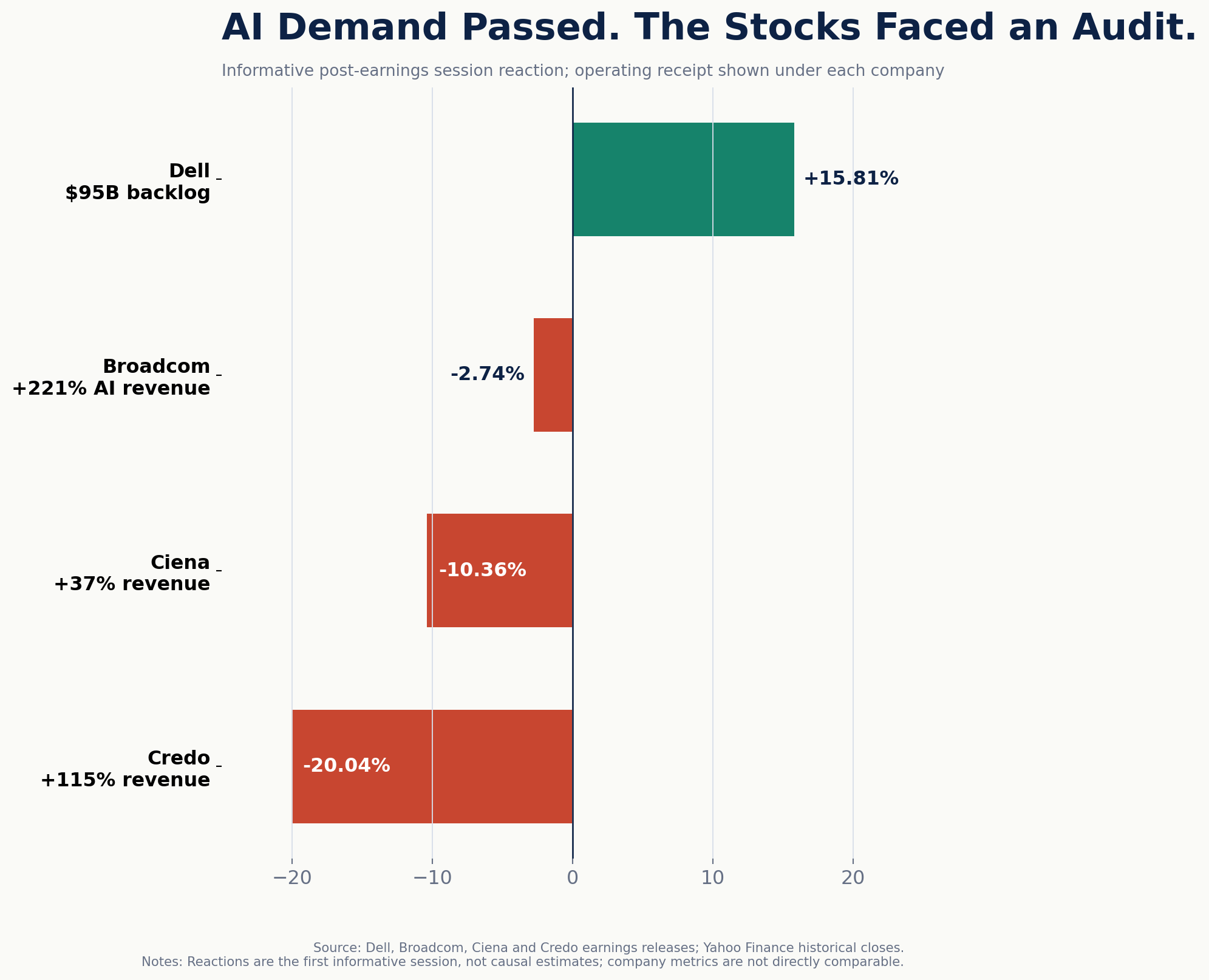
Source: Company earnings releases; Yahoo Finance historical closes. Caveat: first informative-session reactions are not causal estimates, and the operating metrics are not directly comparable.
3. The Fed got two opposite receipts
Payrolls accelerated while oil carried a larger maritime-risk premium. One day earlier, productivity rose with muted unit labor costs and labor share fell to 52.8%. Hot core inflation plus sustained shipping disruption punishes long-duration software and levered infrastructure; benign CPI plus normal throughput lets the Fed treat oil as a supply shock.
The counter-thesis: one week is not a regime. Credo and Ciena may reflect positioning; Dell and Snowflake show strong growth still gets paid. The frame breaks if laggard margins improve without stock follow-through—or indiscriminate AI beta returns.
AI RUNDOWN
• Chips, Memory + Systems: Arm introduced Neoverse CSS N4 with up to 128 cores per die and vendor-claimed gains of up to 2x performance, 1.25x performance per watt and 1.75x memory bandwidth versus CSS N3.
Intel and ASML said High-NA EUV has processed more than one million wafers across qualification, R&D and selected Panther Lake production layers, with overlay, throughput and availability meeting Intel's expectations. Those are fresh efficiency and production-readiness receipts; independent workload results, external foundry customers and economics remain the tests.
HPE rose 5.04% after $12.2 billion of revenue and $2.4 billion of AI orders, then reversed 4.48%.
Micron and
SanDisk await fresh pricing and margin receipts.
• Hyperscalers + Neoclouds: Microsoft Foundry made Astra generally available with pay-as-you-go and provisioned-throughput deployments. Standard short-context list pricing is
$10 per million input tokens and $50 per million output tokens; long-context rates are $20 and $75. OpenAI says AWS Bedrock availability will follow. No provider disclosed Astra usage, revenue or margin, so adoption—not availability—is the next receipt.
• Frontier Models + Agents: OpenAI reports 3.1 eight-hour agent-days per human workday, but more than half of successful four-to-eight-hour tasks still needed intervention. The dividing line is reliable accepted-task completion per dollar, not the loudest AGI benchmark.
• The SaaS Reckoning: Snowflake posted 37% product growth;
UiPath grew 13% and fell 16.63%;
Zscaler grew organic ARR 20% with 7% quarterly FCF margin.
Salesforce reported $33.5 billion cRPO, up 14% constant-currency, but acquisition contribution and bundled AI ARR blur monetization.
Workday grew subscription revenue 13.9% with 11.8% GAAP margin, without paid-AI proof. Workflow context helps; seats, paid attach, inference cost and valuation decide the stock.
Palantir won a $127 million Army production order, strengthening government incumbency, but fell 3.47% versus IGV -4.50% over the aligned event window. The order is small relative to valuation and stock causality is low.
DDOG fell
10.15% without a fresh receipt or volume confirmation; NOW -2.38% and TEAM -0.44% complete a dispersed tape.
Software dispersion rejected both the blanket bear case and the victory lap.
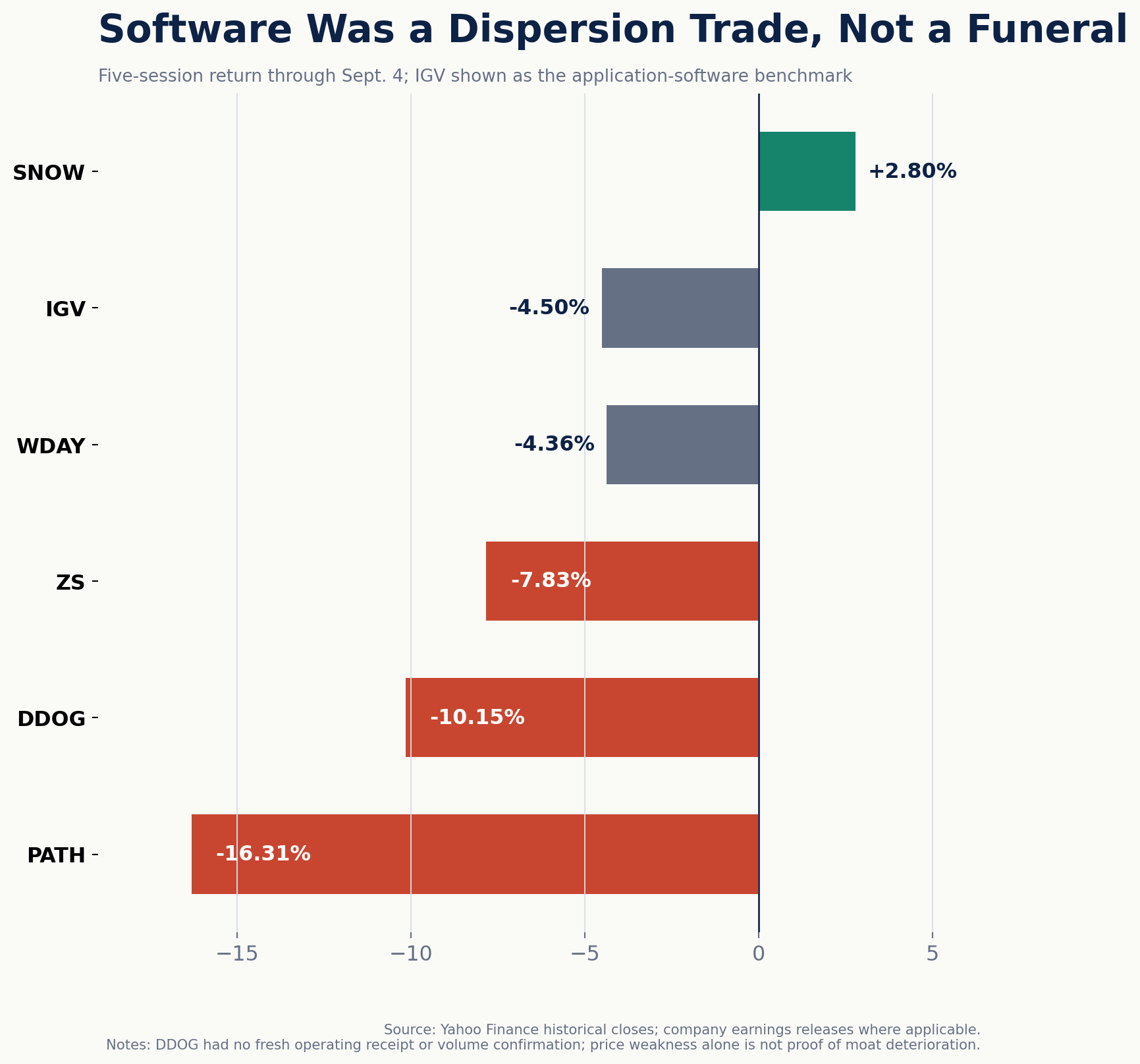
Source: Yahoo Finance historical closes; company releases. Caveat: DDOG had no fresh operating receipt or volume confirmation, so the move remains unexplained rather than attributed to AI disruption.
• Power, Energy + Cooling: Flex agreed to buy EPC Power for
$4.4 billion; its $800 million 2026 revenue and 30% 2027 EBITDA margin are forecasts, with financing undisclosed.
Bloom Energy rose 19.97% versus XLU +0.82%, coinciding with announced inclusion in the S&P 500.
• Deep Cut — Phantom Gigawatts: The Black Line's ladder is campus envelope → approved power → contracted load → delivered IT load → utilization. SEC and grid records support the distinction. Count deposits, tariffs, energization and paying workloads—not press-release megawatts.
• Optics + Physical Infrastructure: Lumentum and
Coherent carried prior-quarter growth of 109.3% and 33.8%;
AAOI more than doubled 800G volume. Current-week
Credo posted 64.5% gross margin and guided Q2 revenue to $525–$535 million;
Ciena guided Q4 to $1.75 billion ±$50 million and about 45% gross margin, with its top two customers at 41.7% of revenue. The next receipts are guide conversion, 1.6T shipments, margin and falling concentration.
The optics cluster confirmed demand and rejected the basket trade.
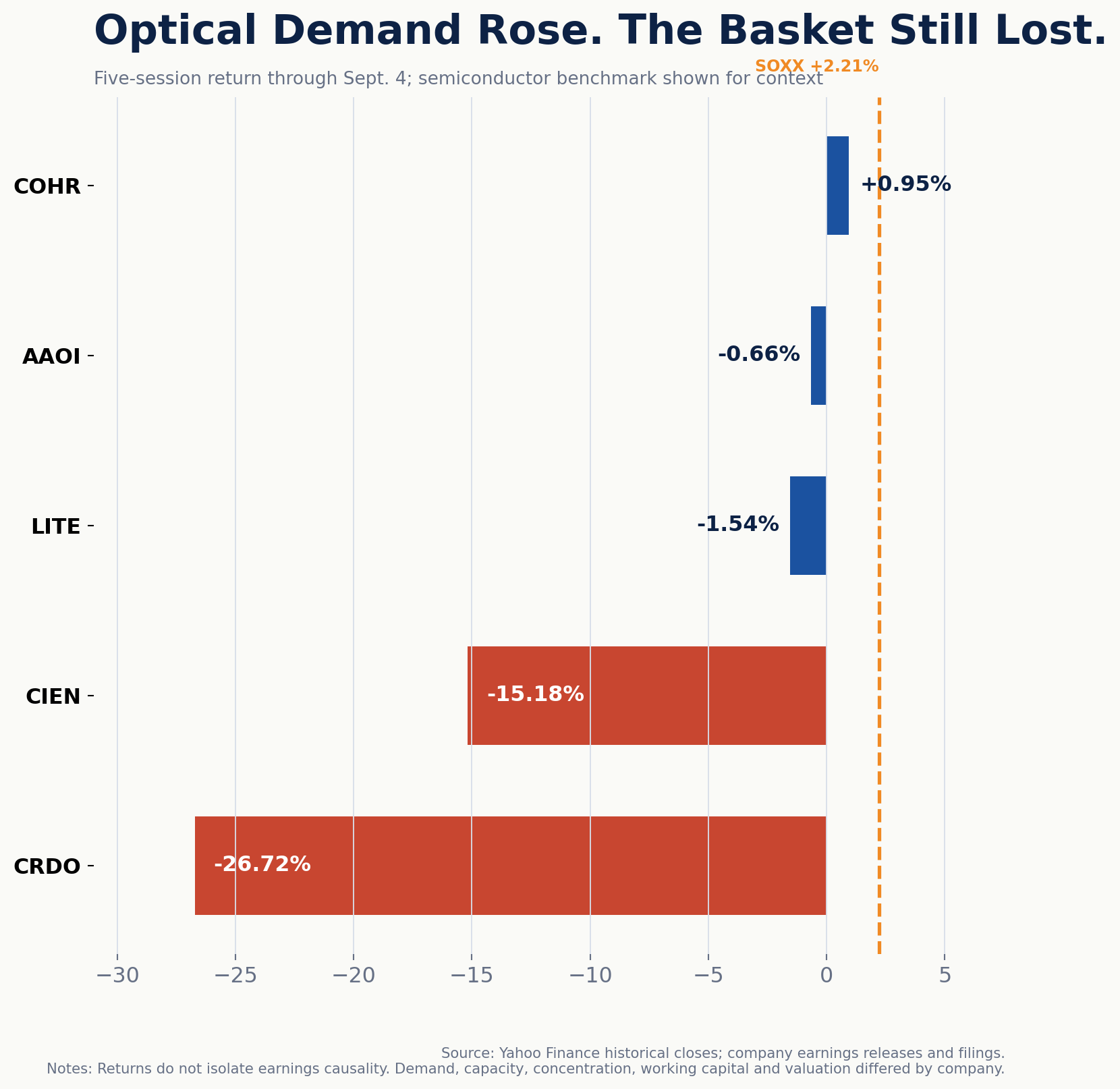
Source: Yahoo Finance historical closes; company filings. Caveat: five-session returns do not isolate earnings causality.
THE BOARD
• September 8: The overnight verdict is risk-off at the margin: futures softened, Brent approached $100, the 10-year held near 4.8% and Bitcoin slipped. Bullish next receipt: Hormuz and Bab el-Mandeb flows normalize while cash-market breadth holds. Bearish: verified throughput loss, carrier withdrawal, Brent above $100 or a renewed yield breakout.
• September 9: Portland votes on datacenter disclosure. Bullish: disclosure only. Bearish: binding zoning or moratorium text. Senator Warnock's Georgia moratorium call is not a bill; watch for a bill, permit action or tariff. Frederick County's agreement is the counter-path.
• September 10–11 / 15–16: PPI, CPI and then FOMC. Bullish: benign core inflation and explicit hold support. Bearish: hot core inflation plus persistent oil triggers tighter guidance. Exposure: software multiples, neocloud financing, crypto and gold.
• Astra deployment: Bullish: independent enterprise workloads confirm long-horizon completion with fewer interventions and attractive successful-task cost across Azure, AWS and OpenAI. Bearish: access friction, false positives, universal-monitoring cost or a real control failure overwhelms the capability gain. CoreWeave and Nebius remain financing and utilization watches until they produce a new operating receipt.
• Q4 / H1 2027: Broadcom must convert its $21.7 billion AI-revenue guide with stable margins;
Flex must close EPC Power without financing stress or target slippage;
NVIDIA must close Hugging Face without remedies, talent loss or developer migration. Demand is no longer the only exam.
ONE MORE THING
FAST READ
• Productivity can be disinflationary while its gains accrue unevenly.
• Distribution backlash is an economic variable: it can slow permits, adoption and the buildout.
U.S. labor share fell to 52.8%, the lowest since the series began in 1947, as AI-system orders exploded. That does not prove causality. It shows why productivity and backlash belong together: technology can be disinflationary and still trigger a distribution fight large enough to slow its buildout.
The audit era
“AI exposure” is no longer enough.
This week the market audited the receipt, the financing, the control layer and the permission slip.
Sources